Size guide · Eco & Kraft Soap Packaging
Handmade Soap Boxes Sizes & Dimensions: A Complete Guide
By the Cosmetic Boxes NYC team · · 6 min read
In this guide
- Why size matters for handmade soap boxes
- Standard handmade soap boxes size chart
- How to measure for handmade soap boxes
- A worked example
- Choosing a size by product and quantity
- Board thickness by size
- Inserts, trays and fit
- Sizes for different sales channels
- Matching sizes across your line
- How size affects cost
- Size and shelf impact
- Sizes for gift sets and kits
- Working with fillers and co-packers
- Custom sizes vs stock sizes
- Size checklist before you order
- Common sizing mistakes
- Questions to ask your packaging supplier
- In summary
Choosing the right size is one of the most important decisions you'll make when ordering custom handmade soap boxes. Get it right and your handmade soap bars look polished, stay protected and fit neatly on shelves. Get it wrong and you pay for wasted board, rattling products or boxes that won't close.
Below you'll find a size chart, a step-by-step measuring method, and practical advice on board thickness, inserts, shelf fit and shipping.
Why size matters for handmade soap boxes
A box that's too large lets handmade soap bars slide and knock against the walls, which can scuff labels, chip glass or crumble soap edges. It also costs more to make, store and ship. A box that's too tight is hard to fill on a production line and can crush caps, pumps and corners.
The right size is snug but easy to pack. For most handmade soap boxes, that means a few millimeters of clearance around the bar, a little extra height for caps or pumps, and room for any insert or leaflet.
Standard handmade soap boxes size chart
These are the sizes we're asked for most often. Dimensions are listed as length x width x height in inches unless noted.
| Size | Dimensions | Best for |
|---|---|---|
| Standard bar | 3.5 x 2.5 x 1.25 in | 4 oz rectangular bar |
| Large bar | 4 x 3 x 1.5 in | 5 to 6 oz bar |
| Loaf slice | 3.25 x 2.25 x 1.25 in | cut-from-loaf bars |
| Gift set of 3 | 8 x 3.5 x 1.5 in | three standard bars |
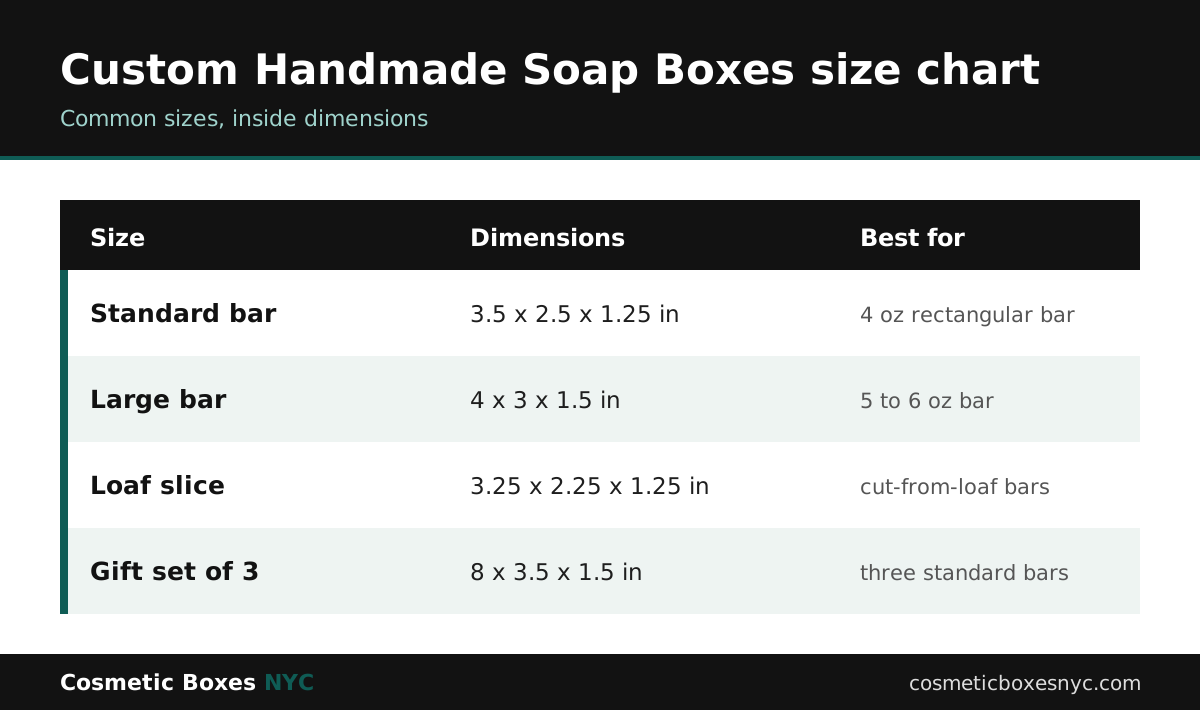
Treat these as starting points. Your exact product dimensions may call for slightly different sizes, and every order can be made to measure.
How to measure for handmade soap boxes
- Measure the bar itself. Use calipers or a ruler on the widest points, including caps, pumps or labels.
- Record length, width and height. Longest side first, then the shorter side, then the tallest point.
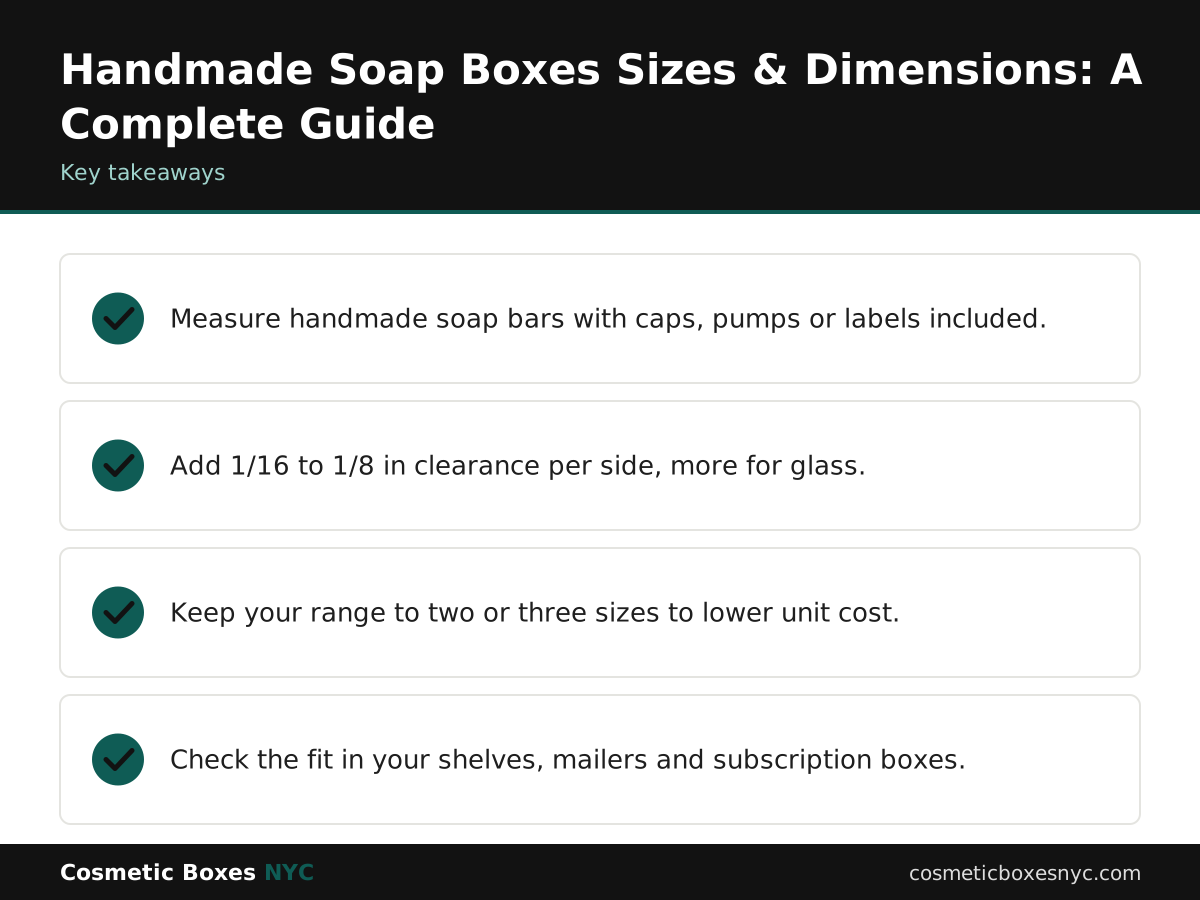
- Add clearance. Allow about 1/16 to 1/8 in per side for easy packing, more for glass or irregular shapes.
- Account for inserts. Add the thickness of any insert, tray, liner or leaflet.
- Use one unit. Stick to inches or millimeters throughout.
We quote by inside dimensions. Board thickness adds to the outside, which matters if the box must fit a shelf, display, shipping mailer or subscription box.
A worked example
Say your bar measures just under the large bar size. Add clearance on each side for easy packing and a little extra height for the cap, and you arrive at about 4 x 3 x 1.5 in, which matches the chart.
Then check the box in your real workflow: does it fit your shipping mailer, does it stand straight on the shelf, and does it close without pressing on the product? If yes, you've found your size for handmade soap boxes.
Choosing a size by product and quantity
Start with how you sell. Trial and travel sizes often use the standard bar (3.5 x 2.5 x 1.25 in). Your core product usually fits the large bar (4 x 3 x 1.5 in). Larger formats and sets move up to the loaf slice (3.25 x 2.25 x 1.25 in) or gift set of 3 (8 x 3.5 x 1.5 in).
A consistent size family also makes your shelf look organized and premium.
Board thickness by size
- Small items: lighter paperboard keeps costs low.
- Standard sizes: a mid-weight board resists crushing and holds sharp corners.
- Large or glass items: heavier board or rigid construction protects fragile products.
- Shipping: add a corrugated mailer or use E-flute for direct-to-consumer orders.
For handmade soap boxes, we usually pair the size with kraft board so the packaging stays crisp.
Inserts, trays and fit
Inserts hold handmade soap bars in place and can make one outer box work for several products. Paperboard inserts, foam, satin pads and molded trays stop movement and protect fragile parts.
If you add an insert, measure the product in the insert and size the box around both.
Sizes for different sales channels
- Retail shelves: sizes that fit standard shelf depths with the front panel facing out.
- E-commerce: compact sizes that fit mailers and reduce shipping costs.
- Subscription boxes: dimensions that fit the box alongside other products.
- Gift sets: larger formats with inserts for multiple items.
- Spas and hotels: small, uniform sizes for amenities.
Matching sizes across your line
Your handmade soap boxes sit beside other products. Choosing a consistent height or width across your line creates a clean shelf block that's easy to recognize.
If you sell sets, measure the full combination and design inserts that hold each item securely.
How size affects cost
Board is priced by area, so every extra inch on handmade soap boxes adds cost across thousands of units. Oversized boxes also need larger shipping cartons and more storage space.
On the other hand, a box that's too tight can mean damaged products and returns. Aim for the smallest size that protects handmade soap bars and presents them well, and consolidate to fewer sizes to lower unit cost.
Size and shelf impact
On a boutique shelf, size communicates value. A slightly taller or wider box for handmade soap boxes gives your logo and product name more room to breathe, while a compact box can look precise and premium if the front panel is designed with care.
Think about facing: how many units fit side by side on a standard shelf, and whether the front panel reads clearly from a few steps away. Retail buyers notice packaging that merchandises well, and it can help you win and keep shelf space.
Sizes for gift sets and kits
Sets need extra planning. Measure every item in the set, decide how they'll sit (side by side, stacked or in a tiered insert), and leave room for tissue, cards or ribbons. For handmade soap boxes, a set box usually works best with a die-cut insert that holds each item in its own cavity.
Keep set sizes consistent across seasons so you can reuse the outer box and change only the sleeve or insert, which saves money on holiday and limited-edition launches.
Working with fillers and co-packers
If a contract filler or co-packer packs your handmade soap boxes, share the box dimensions and a sample early. Automated and semi-automated lines often need specific tolerances, flap styles and glue positions, and a box that's easy to pack by hand may slow a machine down.
Ask your co-packer for their preferred carton style and case count, then we'll design the box to suit both the line and your brand.
Custom sizes vs stock sizes
Stock sizes are fast, but they rarely fit perfectly. Custom handmade soap boxes are built to your products, so you pay for the board you need and your packaging looks professional. With minimums from 100 units, custom sizing is practical for new brands.
If you're between sizes, send us your measurements and a photo. We'll recommend dimensions and can send a plain sample first.
Size checklist before you order
- Have you measured the bar with caps, pumps or labels?
- Did you add clearance?
- Have you allowed for inserts and leaflets?
- Does the box fit your shelves, displays or mailers?
- Have you limited your range to the sizes you need?
- Would a sample help confirm the fit?
Common sizing mistakes
- Measuring the container without its cap or pump.
- Forgetting the insert thickness.
- Choosing a box that doesn't fit your shipping mailer.
- Ordering too many sizes and splitting quantities.
- Skipping a sample for glass bottles.
Questions to ask your packaging supplier
- Which board and finish do you recommend for handmade soap boxes, and why?
- Can you send a plain or printed sample before the full run?
- What are the price breaks at 250, 500 and 1,000 units?
- How long is production after proof approval, and is rush available?
- Do the boxes ship flat, and how are they packed?
Good suppliers answer these quickly and clearly. At Cosmetic Boxes NYC we include recommendations with every quote, so you can compare options side by side.
In summary
The best size for handmade soap boxes fits your product snugly, leaves room for inserts, and works with how you store, sell and ship. Start with the chart, measure your real products, and ask for a sample if unsure.
Ready to order? Request a free quote with your dimensions and we'll reply within one business day.
FAQ
Frequently asked questions
What is the most popular size for handmade soap boxes?
The large bar size, 4 x 3 x 1.5 in, is one of the most requested, but the right size depends on your product.
Can I order handmade soap boxes in a custom size?
Yes. Every order is made to your dimensions, from 100 units.
Do you quote inside or outside dimensions?
We quote inside dimensions, the usable space for your product.
Can I get a sample before ordering?
Yes. We can send a plain sample to check the fit before printing.
How much do custom handmade soap boxes cost?
Price depends on size, quantity, material, printing and finishes. Larger runs lower the unit price. Send your specs through the quote form for tiered pricing within one business day.